The AI Infrastructure Reset: Why Power, Gold, and Cash Flow Matter More Than Hype
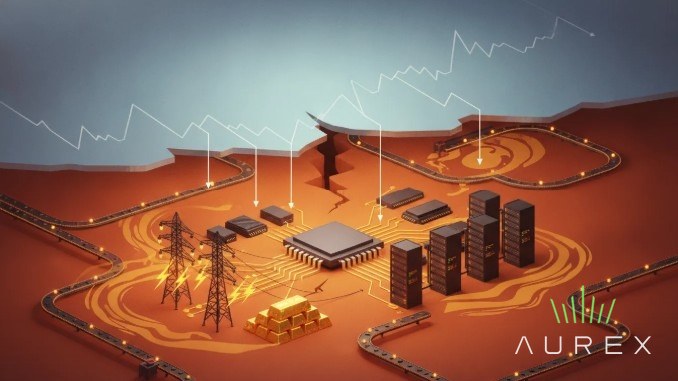
This market looks calm on the surface. Underneath it, capital is rotating fast — away from financial narratives and toward physical scarcity, power capacity, and verifiable cash flow. This market looks calm on the surface. Underneath it, capital is rotating fast. Equal-weight equities are holding…
This market looks calm on the surface. Underneath it, capital is rotating fast — away from financial narratives and toward physical scarcity, power capacity, and verifiable cash flow.
This market looks calm on the surface. Underneath it, capital is rotating fast.
Equal-weight equities are holding up, while many companies supplying the physical backbone of artificial intelligence, including semiconductors, memory manufacturers, chip equipment firms, and data center operators, face sharp drawdowns. At the same time, inflation pressures remain embedded in essential household costs, supply-chain risks are rising, and central banks are accumulating gold.
The core investment question is straightforward: are markets still rewarding financial narratives, or are they beginning to reward physical scarcity, productive assets, power capacity, and verifiable cash flow?
Below is the framework I would use to assess this transition, manage a tech-heavy portfolio, and identify where the next capital rotation may occur.
QUICK SUMMARY: WHAT IS HAPPENING RIGHT NOW
The equal-weight S&P 500 has remained strong, suggesting the average company is holding up better than headline technology indices imply.
AI infrastructure stocks, including semiconductor, memory, and data center-related companies, have experienced severe volatility and pullbacks.
Capital is moving away from highly speculative hardware exposure and toward established mega-cap technology companies and cash-generative sectors.
The AI buildout faces a major mismatch: long-lived physical assets are being funded using revenue assumptions based on short-term compute and memory pricing.
AI model efficiency does not necessarily reduce data center demand because power, grid access, and electrical capacity are the real bottlenecks.
Sticky inflation in household essentials, potential energy shocks, and stress in the Japanese yen carry trade could pressure bond yields higher.
Global policy is shifting toward tariffs, industrial subsidies, domestic manufacturing, and strategic control of supply chains.
Gold accumulation by China and other central banks signals rising concern over the long-term role of the U.S. dollar in global trade.
Portfolio construction now matters more than chasing the highest-beta AI ticker.
THE CORE QUESTION
Are markets still rewarding financial narratives, or are they beginning to reward physical scarcity, productive assets, power capacity, and verifiable cash flow?
There Are Two Different Stock Markets Right Now
The first market is the broad market. The equal-weight S&P 500 treats companies more evenly than the traditional capitalization-weighted index. When it reaches new highs, it indicates that many ordinary businesses are participating in the rally.
The second market is concentrated technology infrastructure. This includes the companies building chips, supplying memory, manufacturing equipment, constructing data centers, and financing the physical systems required to run AI workloads.
Those infrastructure names have become increasingly volatile. In several cases, the decline has approached 30% from recent highs. Markets heavily exposed to memory manufacturing, such as South Korea, can feel this pressure immediately because firms such as Samsung and SK Hynix carry outsized importance in their domestic market structure.
This is not simply a broad market selloff. It is a rotation. Investors are increasingly choosing established mega-cap platforms, including companies such as Apple and Meta, over higher-risk infrastructure businesses with large capital requirements. The market is effectively asking one question: which companies can fund the AI race without destroying returns on invested capital?
The AI CapEx Problem: Long-Term Assets Funded by Short-Term Prices
The AI infrastructure boom has been compared to the telecom fiber buildout of the late 1990s and early 2000s. The comparison matters because telecom companies built enormous capacity based on assumptions that demand would remain permanently elevated. The issue was not that the internet failed. The internet changed the world. The issue was that too much infrastructure was built too quickly, often at valuations and capital structures that could not survive when pricing normalized.
AI infrastructure faces a similar risk, but at a much larger scale. Companies are committing hundreds of billions of dollars to data centers, chips, power systems, cooling infrastructure, memory, and networking. These are long-duration assets. A large data center may need to generate returns over decades. Yet much of the investment case is based on current spot pricing for compute. Spot pricing means the premium a provider can charge today to rent computing capacity, memory, or chips during a period of tight supply. That creates a duration mismatch:
Data centers and power infrastructure may last 20 years or longer.
Current compute pricing can change quickly as supply expands or demand shifts.
High current margins are being treated as if they are permanent.
Capital expenditure must be paid regardless of whether future pricing remains attractive.
Think of it as building a luxury hotel based on one exceptional holiday weekend. The hotel may be a valuable asset. But the underwriting fails if management assumes peak room rates will persist for the next 20 years.
Why Valuation Discipline Matters in the Hardware Trade
NVIDIA sits at the center of the AI infrastructure ecosystem because it designs the chips that enable much of the current buildout. Its intellectual property, software ecosystem, and market position give it a distinct strategic advantage. That creates a useful valuation discipline: peripheral hardware businesses should not automatically trade at richer valuation multiples than the company controlling the most valuable core technology. When a lower-quality or more capital-intensive supplier trades at a premium to the platform company with the stronger moat, the market may be pricing in unrealistic expectations.
This is particularly relevant for companies that must own and finance physical data centers. A shift toward an asset-light model by a cloud provider can be an important signal. It may indicate that owning the infrastructure is becoming too capital intensive, too power constrained, or too difficult to justify at prevailing returns. Asset-light strategies can improve flexibility. They can also reveal that the economics of owning the underlying assets are deteriorating.
AI Efficiency Is Bullish for Power-Constrained Data Centers
One apparent contradiction is confusing investors: AI models are becoming more efficient, yet demand for compute remains intense. New model-development techniques, including distillation, allow a smaller model to learn from the outputs and reasoning patterns of a larger model. Instead of training every model from raw human-labeled data, developers can use refined outputs from an already-trained “teacher” model to train a more efficient “student” model. That can dramatically reduce the resources required for certain workloads.
At first glance, this seems bearish for infrastructure. If models require less compute, why would the industry need more data centers?
“The answer is power.”
THE REAL BOTTLENECK
Data center growth is increasingly constrained by electrical capacity, grid access, transmission infrastructure, substations, cooling, and local permitting. If a company can generate more AI output per watt of power, it can produce more revenue from its existing site without waiting years for a new facility and additional grid capacity. Efficiency therefore increases the yield on scarce physical infrastructure. This is a critical distinction:
Efficiency can reduce compute needed per task.
Lower costs can expand adoption and create more workloads.
Power capacity limits how much total computing can be delivered.
Operators with secured power access may become more strategically valuable.
The winners may not be the companies with the loudest AI branding. They may be the companies that control electricity, grid connections, land, cooling, and dependable energy supply.
Hardware Hoarding Is an Inflation and Supply-Chain Signal
Corporate behavior also shows that supply-chain anxiety has not disappeared. When customers pause software spending in order to stockpile memory, storage, and servers ahead of potential tariff increases, they are making a clear economic decision. They believe physical technology may become materially more expensive or difficult to obtain.
This matters because it shifts spending from discretionary software budgets into hard assets. It also reinforces a broader inflationary concern: companies are treating physical inventory as a hedge against future price increases. That behavior does not support the idea that inflation is fully defeated. It supports the idea that inflation risk has moved from broad consumer demand into strategic supply chains, trade policy, energy, and industrial inputs.
Why Headline Inflation Can Look Fine While Households Still Feel Pressure
Headline inflation data can soften while essential household expenses remain painful. This is the difference between broad price indices and the categories that consumers cannot easily avoid. Housing, auto insurance, energy, and other recurring costs can remain elevated even when the overall inflation rate improves. Households react by cutting back where they can.
This creates what can be described as “funflation.” Consumers trade down on groceries and physical goods, but continue spending on experiences such as travel, live sports, entertainment, and concerts. The behavior is rational. Everyday necessities consume more of the budget, so consumers protect the experiences they value most while reducing spending on items where cheaper substitutes are available. For investors, this has sector implications:
Low-cost consumer products can gain share as households trade down.
Experience-driven spending can remain resilient longer than expected.
Companies exposed to essential services may retain pricing power.
Businesses dependent on discretionary physical goods may face pressure.
Oil, the Yen Carry Trade, and the Bond Market Risk
Markets are also managing two potential macro shocks: energy supply disruption and currency stress. Major disruption in Middle Eastern shipping routes could remove a substantial volume of oil from global markets. A move in crude oil toward $100 per barrel would raise transportation, production, and consumer costs across the economy. At the same time, weakness in the Japanese yen can affect U.S. Treasury markets through the yen carry trade. The yen carry trade works like this:
Investors borrow yen at very low Japanese interest rates.
They convert the borrowed yen into dollars or other currencies.
They buy higher-yielding assets, often including U.S. Treasury bonds.
They profit from the interest-rate difference, assuming currency conditions remain stable.
The trade becomes dangerous when the yen weakens sharply or Japanese interest rates rise. Investors may need to reverse the trade by selling foreign assets, repurchasing yen, and repaying their loans. If large amounts of U.S. Treasuries are sold during an unwind, bond prices decline and Treasury yields rise. Higher yields then tighten financial conditions for households, companies, and governments. The risk is a negative feedback loop:
Higher oil prices push inflation higher.
Sticky inflation limits central bank flexibility.
Carry-trade unwinds increase Treasury yields.
Higher yields raise borrowing costs across the economy.
Equity valuations face pressure because future earnings are discounted at higher rates.
A low volatility index does not eliminate these risks. It can indicate that markets are complacent while structural pressures build underneath.
The Return of Hamiltonian Economics
The United States is attempting a major economic pivot: less dependence on cheap imported goods and more domestic industrial capacity. This approach resembles Hamiltonian economics, named after Alexander Hamilton, the first U.S. Treasury Secretary. The basic model uses tariffs, industrial policy, subsidies, and domestic investment to build strategic manufacturing capacity.
The policy objective is understandable. Semiconductors, energy systems, industrial machinery, defense supply chains, and critical materials have become national-security issues as much as economic issues. But reindustrialization has a built-in tradeoff.
The Impossible Trinity of Reindustrialization
The United States cannot easily achieve all three of the following objectives at once:
Rebuild domestic manufacturing at scale.
Keep imported consumer goods cheap.
Maintain a highly overvalued U.S. dollar.
A strong dollar makes imported goods cheaper for U.S. consumers. But it also makes U.S.-manufactured goods more expensive for foreign buyers. If American factories are expected to compete globally, the currency may need to weaken relative to trading partners. That may improve export competitiveness. It also makes imports more expensive for households. This is the central policy tension. Reindustrialization may require accepting a weaker dollar or higher consumer prices, particularly during the transition.
Why Central Banks and Chinese Investors Are Accumulating Gold
Gold is becoming more important because it is neutral. It is not the liability of a government, a bank, or a central bank. China has seen substantial interest in physical gold exposure through exchange-traded products, while the People’s Bank of China has continued adding to its gold reserves. The strategic logic is clear: if the global trading system becomes less dollar-centric, countries will seek reserve assets that are broadly recognized and politically neutral.
This concept resembles John Maynard Keynes’ proposal at Bretton Woods for a neutral international reserve currency called the Bancor. The world instead adopted a dollar-centered system. Today, no Bancor exists. Gold remains the historical alternative reserve asset.
Some extreme calculations illustrate the scale of the issue. If a country attempted to settle a massive trade surplus using only a limited annual quantity of physical gold, the implied price per ounce would need to rise dramatically to carry the value of that trade. The precise number is less important than the conclusion: there is not enough gold at current prices to settle global trade at scale without a substantial repricing. This does not mean gold must immediately reach an extreme target. It means gold is being reconsidered as a strategic monetary asset in a world of tariff disputes, fragmented trade, rising sovereign debt, and potential currency devaluation.
What This Means for a Tech-Heavy Portfolio
Do not panic sell. Panic is not a strategy. Do not remain complacent either. A portfolio concentrated in high-beta semiconductor and AI infrastructure names can produce gains during risk-on periods, but it can also fall much faster than the broader market during a correction. Beta measures a security’s sensitivity to market movement. A portfolio with a beta of 2.0 is expected, in broad terms, to move about twice as much as the market. If the market declines 10%, that portfolio could decline roughly 20%. Start with a portfolio audit.
Step 1: Measure Your Concentration
Identify how much of your portfolio is exposed to the same underlying theme:
Semiconductors
Memory and storage
Chip equipment
Cloud infrastructure
Data center operators
Unprofitable AI-adjacent companies
Owning ten different technology tickers does not create diversification if all ten depend on the same AI capital-spending cycle.
Step 2: Know the Portfolio’s Beta
Calculate portfolio beta and assess how much volatility you are truly holding. Modern tools can help estimate portfolio beta from a list of positions, share counts, and market values. The goal is not to eliminate volatility. The goal is to make volatility intentional.
Step 3: Separate Durable Businesses From Momentum Narratives
Focus on free cash flow. Free cash flow is the cash remaining after a company pays operating expenses and maintains the capital assets required to run the business. It is harder to manipulate than an ambitious growth narrative. During major market transitions, free cash flow provides flexibility. It allows a company to invest, reduce debt, repurchase shares, pay dividends, or survive a downturn without relying on capital markets. Ask these questions for every major holding:
What does the company sell?
Who pays for it?
Does it generate free cash flow today?
How much capital expenditure is required to sustain growth?
Is the valuation based on current economics or distant assumptions?
What happens if AI infrastructure pricing normalizes?
Where Capital May Rotate Next
Capital does not disappear when one sector sells off. It moves. Financial companies can benefit when merger and acquisition activity accelerates. Large banks and investment banks may gain from advisory fees, underwriting, trading activity, and capital markets activity. Health care has also historically shown resilience during periods of political and economic uncertainty, including midterm election cycles. The broader point is not to blindly buy a sector because of a calendar pattern. The point is to avoid treating technology as the only source of investable opportunity.
Energy, utilities, industrials, and infrastructure deserve more attention if power availability becomes the binding constraint on AI expansion. The next trillion-dollar winners may not be the companies building the most exciting model. They may be the companies that own the electricity, grid capacity, fuel supply, transmission network, and physical infrastructure required to operate that model.
Why the Debt Market Matters More Than the Hype Cycle
Equity markets can reward vision for long periods. Debt markets are generally less forgiving. A company can have an extraordinary brand, a compelling technological mission, and a major addressable market. But if its cost of capital rises, its funding needs expand, or its cash flows cannot support its valuation, debt investors will challenge the story. This is why market participants should pay close attention to capital intensity, debt financing, refinancing needs, and the spread between projected returns and the actual cost of capital.
“The equity market may buy the dream. The debt market demands the math.”
EQUITY VS. DEBT
Practical Portfolio Framework for This Market
Reduce unintentional concentration. Do not let semiconductors, AI hardware, and cloud infrastructure become an oversized portion of your assets by default.
Favor free cash flow. Companies with real cash generation are better positioned to navigate higher rates and economic uncertainty.
Understand capital intensity. Businesses requiring huge data center, power, or equipment investment need durable returns, not temporary demand spikes.
Assess power exposure. Data centers require electricity. Utilities, energy suppliers, grid infrastructure, and industrial providers may capture more of the AI economics than expected.
Maintain hard-asset awareness. Gold, commodities, energy, and real-world infrastructure can serve as diversification tools when monetary and geopolitical risks rise.
Use position sizing. High-beta positions should be sized for the downside, not for the most optimistic upside narrative.
Watch bond yields. Rising yields can pressure long-duration technology valuations even if the underlying businesses remain strong.
Conclusion: The Market Is Moving From Paper Promises to Physical Constraints
The AI revolution is real. That does not mean every AI-related stock is a good investment at every valuation. The market is increasingly confronting a basic reality: compute requires chips, chips require supply chains, data centers require power, power requires physical infrastructure, and infrastructure requires capital. Those constraints will determine returns.
The next decade may be defined by a rotation away from purely financialized assets and toward companies that control scarce, productive, real-world resources. Electricity, energy, industrial capacity, critical materials, grid access, manufacturing, and gold are no longer side topics. They are central variables in the global investment landscape.
THE TAKEAWAY
Know what you own. Know the beta you are carrying. Demand free cash flow. Do not confuse a great technology with an automatically great investment.
SOURCES
Federal Reserve. Monetary Policy and Economic Data, federalreserve.gov/monetarypolicy.htm
International Monetary Fund. Inflation, imf.org/en/Topics/inflation
Bank for International Settlements. Foreign Exchange and Global Financial Conditions, bis.org
World Gold Council. Gold Demand Trends
U.S. Department of Energy. Office of Electricity, energy.gov/oe/office-electricity
U.S. Department of the Treasury. Exchange Rate Policies
IMPORTANT DISCLAIMER: This document is provided for informational and educational purposes only. It does not constitute investment, legal, tax, or other professional advice, and nothing contained herein should be construed as a recommendation, an offer to sell, or a solicitation of an offer to buy any security or other financial instrument, in any jurisdiction. The information presented is obtained from sources believed to be reliable, but its accuracy and completeness are not guaranteed, and certain figures are estimates that may prove incorrect. Past performance is not indicative of future results, and all investments involve risk, including the possible loss of principal. Readers must conduct their own independent research and due diligence and should consult a duly licensed financial, legal, or tax professional regarding their individual circumstances before making any investment decision. The author and ACapital Group LLC accept no liability for any loss arising from the use of this material.
We use cookies to analyze website traffic and optimize your website experience. By accepting our use of cookies, your data will be aggregated with all other user data.



Comments (0)
No comments yet — be the first.