
Quick summary - what you need to know right now
-
Iran has threatened to attack vessels transiting the Strait of Hormuz, a choke point that normally carries roughly 20 million barrels per day or about 20 percent of global oil shipments.
-
The closure is driven by the threat and use of force, not by a legal blockade that other states can easily resolve.
-
Immediate obstacles to shipping are insurance refusals and heightened operational risk, not physical closures alone.
-
Markets currently price this as a short term shock, but a multiweek closure would push oil well above 100 USD per barrel and materially increase recession risk.
Why Iran can cause a shutdown
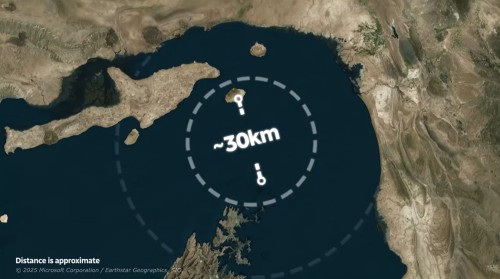
Control of the Strait of Hormuz rests more on force than on law. The narrowest point is just over 30 kilometres wide, which puts much of the waterway inside coastal territorial claims for Iran and Oman. International law recognizes the right of transit passage, but law does not stop missiles, mines, or targeted attacks when a state has the will and the means to make passage unsafe.
States bordering straits shall not hamper transit passage
Translation: Iran’s action is illegal under international law, but illegality does not prevent disruption. The state that can make passage unsafe effectively controls whether commerce flows through the strait until that state’s cost-benefit calculation changes.
The immediate mechanics of the disruption
-
Physical threat: Attacks on ships or credible threats raise immediate safety concerns for seafarers and owners.
-
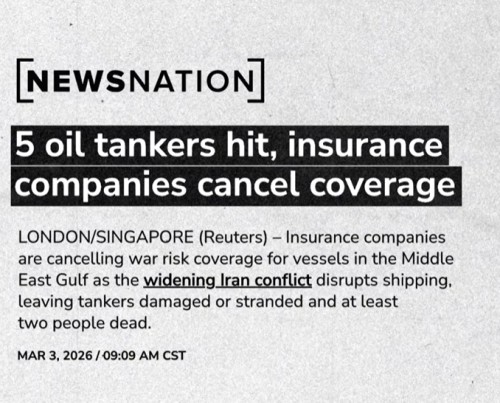
Insurance evacuation: Hull and cargo insurers withdraw or severely limit cover for transits, which is the single largest practical barrier to shipping.
-
Commercial refusals: Crews and shipping companies exercise the right to refuse to sail through designated high risk zones.
-
Rerouting impracticality: Alternatives, such as sailing around Africa, add time and cost and cannot match current throughput. Regional pipelines lack the capacity to replace lost volumes.
How this translates to prices and the real economy
Oil prices are set on a global market. A supply shock in the Strait of Hormuz affects buyers everywhere because crude is fungible and traded globally. Expect two primary channels of impact:
-
Immediate price shock: Less oil flowing through the main shipping lane raises near term scarcity. If the disruption persists longer than a few weeks, expect Brent to rise materially and gasoline prices at the pump to follow.
-
Macro second order effects: Higher energy input costs act like a sudden tax on consumers and businesses. Transportation, manufacturing, and supply chain costs increase. If sustained, higher energy prices reduce discretionary spending and can push an economy toward recession.
Market context matters. The United States is producing record crude and there is spare global capacity and strategic petroleum reserves that can absorb moderate shocks. That is why short disruptions produce price spikes, not immediate systemic collapse. If disruption lasts many weeks, those cushions shrink and price behavior becomes more volatile and damaging.
What the United States and allies can realistically do
Options exist, each with limits and trade offs. Think of responses as operational, financial, or diplomatic.
-
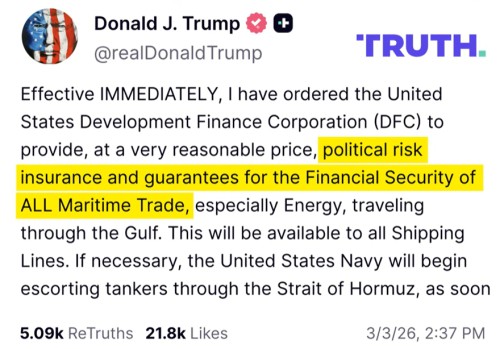
Military escorts and interdiction provide direct protection but carry escalation risk and are resource intensive. Escorts reduce some risk for convoys, but they do not restore commercial insurance automatically.
-
Financial backstops can be offered to insurers and shipowners. A government guarantee can restore commercial flows faster than military action alone, but it requires clear policy design and willingness to underwrite large contingent liabilities.
-
Release strategic reserves to stabilize markets temporarily. This buys time but does not fix the underlying transit risk.
-
Diplomacy and side deals aim to lower the political incentive for disruption. Markets price the probability of such arrangements when commercial pain becomes widespread.
Practical timeline and the insurance problem
Insurance is the choke point. Even if naval forces are present, major underwriters must be comfortable with residual risk. Once insurers pull cover, hundreds of ships may refuse to enter the strait. Re-insuring that risk requires either demonstrable reduction of threat or government-backed indemnities.
Scenario analysis - three outcomes and their market implications
-
Short disruption (days to two weeks)
Price impact: modest spike, markets calm as reserves and spare capacity plug gaps. Business impact: manageable; consumer pain limited to higher pump prices for several weeks. -
Medium disruption (3 to 6 weeks)
Price impact: Brent likely above 100 USD per barrel. Strategic reserve releases and increased US production mitigate but cannot fully replace volume. Business impact: clear drag on growth, meaningful inflation impulse, signs of consumer contraction. -
Prolonged disruption (multiple months)
Price impact: sustained high prices, volatile markets, rationing pressure on refined fuels. Business impact: elevated recession risk, severe supply chain stress, global second round inflation effects.
Impact on Stock Portfolio
The primary risk here is "Stagflationary Pressure." Higher energy costs act as a tax on consumers, while simultaneously forcing the Federal Reserve to keep interest rates "higher for longer" to combat energy-driven inflation.
1. The "Losers": Tech, Discretionary, and Industrials
-
Tech (Growth): High-growth stocks (e.g., NVDA, MSFT) are hypersensitive to interest rates. If oil stays above $100/bbl, inflation fears will spike, driving up Treasury yields and crushing tech valuations.
-
Transportation & Retail: Airlines (DAL, UAL) and logistics (UPS, FDX) will see immediate margin compression from fuel costs. Consumer discretionary (AMZN, TSLA) will suffer as households spend more at the pump and less on goods.
2. The "Winners": Energy and Defense
-
Upstream Oil & Gas: Companies with production outside the Persian Gulf are the primary beneficiaries. Look at US-based majors like Chevron (CVX) and Occidental Petroleum (OXY), which provide a "geopolitical hedge."
-
Defense Contractors: Increased naval activity and the risk of escalation favor companies like Lockheed Martin (LMT) or Howmet Aerospace (HWM), which are already seeing strong 2026 demand.
Impact on Crypto Portfolio
In 2026, the "Digital Gold" narrative is being put to a brutal test.
-
Short-Term (Risk-Off): Initially, Bitcoin (BTC) and Ethereum (ETH) tend to correlate with tech stocks. Expect a sharp sell-off (the "hesitation period") as traders dump liquid assets to cover margins in other falling sectors.
-
Medium-Term (The Pivot): If oil stays above $110, analysts suggest BTC may break its correlation with stocks. If the USD weakens due to recession fears, the "inflation hedge" narrative could trigger a massive rebound.
-
Stablecoin Opportunities: High-interest environments favor stablecoin issuers like Circle, as they earn higher yields on the cash backing their coins.
Bottom line
The Strait of Hormuz problem is not an abstract legal dispute. It is a leverage point controlled by force and risk economics. Short term, global markets can absorb shocks using spare capacity and reserves. If the disruption persists, price spikes and macro damage are unavoidable. Financial players and corporate treasuries must act like risk managers: quantify exposure, secure liquidity, and hedge where it matters.
Sources and further reading
United Nations Convention on the Law of the Sea (UNCLOS): https://www.un.org/Depts/los/convention_agreements/texts/unclos/unclos_e.pdf
U.S. Energy Information Administration: https://www.eia.gov
International Energy Agency: https://www.iea.org
International Transport Workers Federation (ITF): https://www.itfglobal.org
Recent reporting and market context: Reuters and major financial outlets on Strait of Hormuz incidents




Comments (0)
No comments yet — be the first.